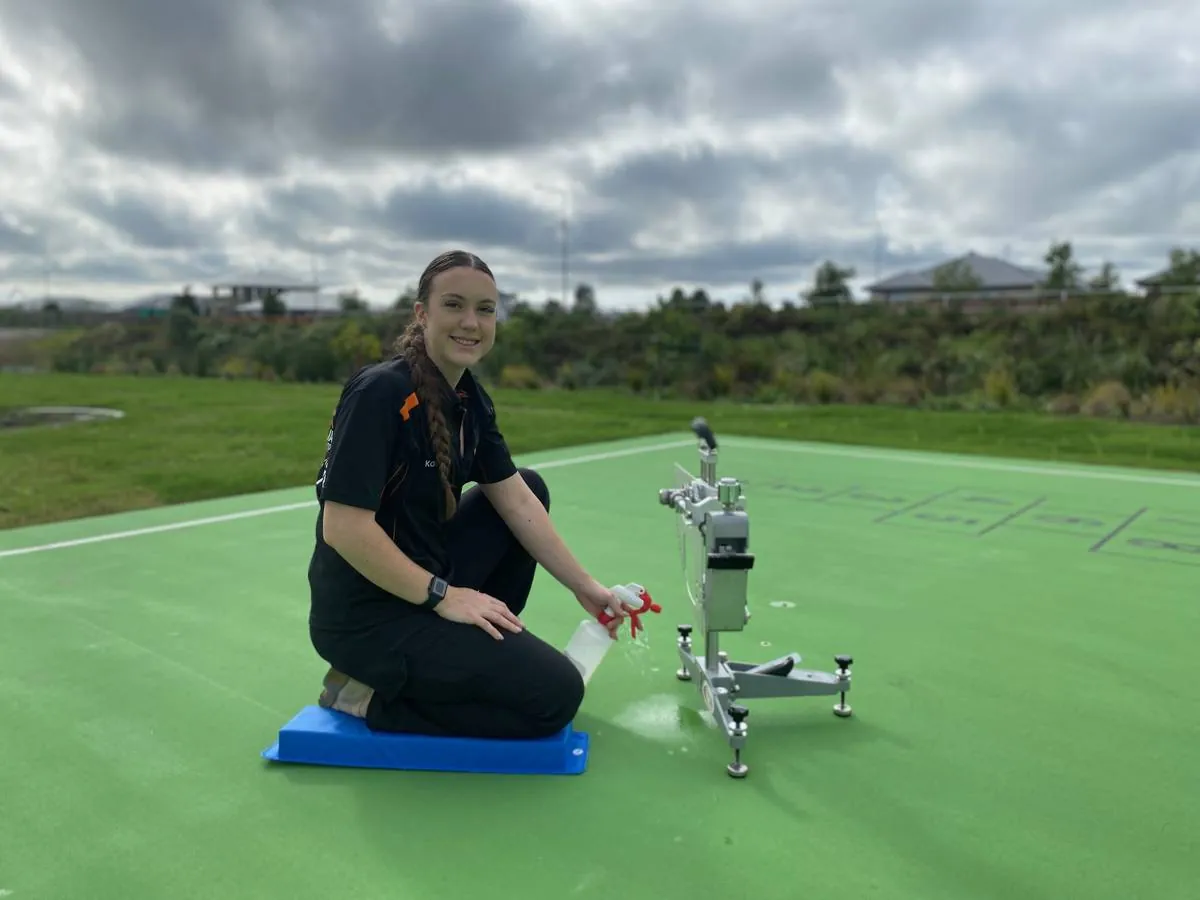
Wet pendulum slip resistance testing is the reference method in Australia for finding out whether a floor is safe to walk on when it is wet. It is the method written into AS 4663 for floors already in service and AS 4586 for new surface materials, and it produces the P rating (P0 to P5) that the National Construction Code, HB 198 and most building specifications refer to.
Sliptest Australia has carried out wet pendulum testing since 2004 and has held NATA accreditation No. 15374 for it since 2006. Our technicians test across South East Queensland, Sydney and Melbourne every week, visit Perth twice a year and travel to Canberra, Adelaide and regional centres on demand, and our slip resistance reports are NATA-endorsed so they can be relied on by building certifiers, facility managers, insurers, body corporates and legal teams.
This page explains how the test works, what the result means, when you need it, and how to book it. If you already know what you need, request a quote and we will confirm scope and pricing within one business day.
The pendulum was developed by the UK Transport Research Laboratory and is sometimes called the British Pendulum or TRL pendulum. The Australian method controls the slider, the wetting, the number of swings and the conditioning of the rubber so that results are repeatable between laboratories.
We agree the test locations with you in advance: entries, ramps, stairs, wet areas, kitchens, external paths. Each distinct surface and risk zone is tested separately.
The pendulum is levelled on the floor, the swing is zeroed and the slider contact length is set to the standard. Calibration records are kept under our NATA quality system.
Slider 96 for shod areas, Slider 55 for wet barefoot areas such as pool surrounds and showers. The slider is conditioned before testing as the standard requires.
The test area is flooded with water and the pendulum arm is released. As the rubber slider drags across the wet floor it loses energy, and the arm's follow-through is read on the scale as a BPN.
Five readings are taken in each direction and the mean is calculated. Testing in more than one direction picks up directional surface texture such as brushed concrete or profiled tiles.
The mean BPN is converted to a P classification and compared with the requirement for that location. Your NATA-endorsed report is issued within 24 hours of the site visit.
AS 4586 and AS 4663 convert the mean British Pendulum Number into one of six classifications. The classification is what specifications, the NCC and HB 198 refer to. The table below shows the bands and where each classification is typically required. Requirements for a specific building come from the NCC, the design specification or the relevant Australian Standard, and our report identifies which one applies.
| Classification | Mean BPN (wet pendulum) | Typical locations where it is required |
|---|---|---|
| P5 | 55 and above | External ramps steeper than 1:14, commercial kitchens, swimming pool ramps and stairs into water, loading docks, wet ramps in new buildings under the NCC |
| P4 | 45 to 54 | External walkways and colonnades, external ramps up to 1:14, entry foyers when wet, pool surrounds, stair treads and landings when wet under the NCC |
| P3 | 35 to 44 | Entry foyers when dry, shopping centre malls and food public toilets, stair treads and landings when dry under the NCC |
| P2 | 25 to 34 | Dry internal areas with low slip risk, such as offices and hotel corridors |
| P1 | 12 to 24 | Rarely acceptable for pedestrian areas other than dry, level, low-traffic zones |
| P0 | Below 12 | Not suitable for any pedestrian area when wet |
Clients often ask for a "coefficient of friction test" because that is the term used on product data sheets and in some overseas standards. In Australia the two tests do different jobs, and asking for the wrong one is a common reason a report is rejected by a certifier.
Wet pendulum test (AS 4663 / AS 4586 Appendix A). Measures wet slip resistance and gives a BPN and a P classification. This is the test the NCC, HB 198, certifiers and insurers refer to for pedestrian floors. It is the test you need in almost every case.
Dry floor friction test (AS 4663 / AS 4586 Appendix B). A Tortus, a motorised floor friction tester, drags a rubber slider across a dry floor and reports a coefficient of friction and a D classification (D0 below 0.40, D1 at 0.40 or above). It only describes the floor when dry, so it cannot show whether a floor is safe in the wet conditions that cause most falls.
Sliptest carries out both tests under NATA accreditation. If your specification, insurer or lawyer has asked for a coefficient of friction, we will confirm which classification they actually need before we attend so you only pay for the test that answers the question.
| Floor gets wet in use | Wet pendulum |
| Certifier, NCC or HB 198 requirement | Wet pendulum |
| Insurance claim or litigation | Wet pendulum, sometimes both |
| Always-dry internal floor | Dry friction, often with pendulum |
| Product data sheet quotes "COF" or "R rating" | Ask us, these are not P ratings |
AS 4663 is for floors that are already installed. These are the situations where an independent wet pendulum test is either required or is the only defensible position.
For new floors at practical completion the test is done to AS 4586 on-site. See construction handover slip testing. For classifying a product before it is installed, see laboratory slip testing to AS 4586.
Portfolio testing programs for shopping centres, commercial towers, aged care and healthcare.
Pool surrounds, lobbies, car parks and common area stairs in residential and mixed-use buildings.
Existing surfaces in refurbishment projects, and retesting after rectification.
Independent evidence of floor condition after a slip and fall claim.
NATA-endorsed test results for personal injury and liability matters.
Aquatic centres, transport interchanges, libraries, schools and public buildings.
Tell us the site, the areas and roughly how many locations. We will confirm scope, price and the next available date within one business day.
For urgent enquiries call 1300 SLIPTEST.
NATA-endorsed report within 24 hours of the site visit. East coast every week. Perth twice a year. Adelaide on demand.