AS 4586 · P0 to P5 · NATA No. 15374

Laboratory Slip Resistance Classification to AS 4586

P rating classification of tiles, stone, vinyl, timber, coatings and other new surface materials in our NATA-accredited laboratory. The independent classification manufacturers, specifiers and builders need before a product is installed.

Request a Quote 1300 SLIPTEST
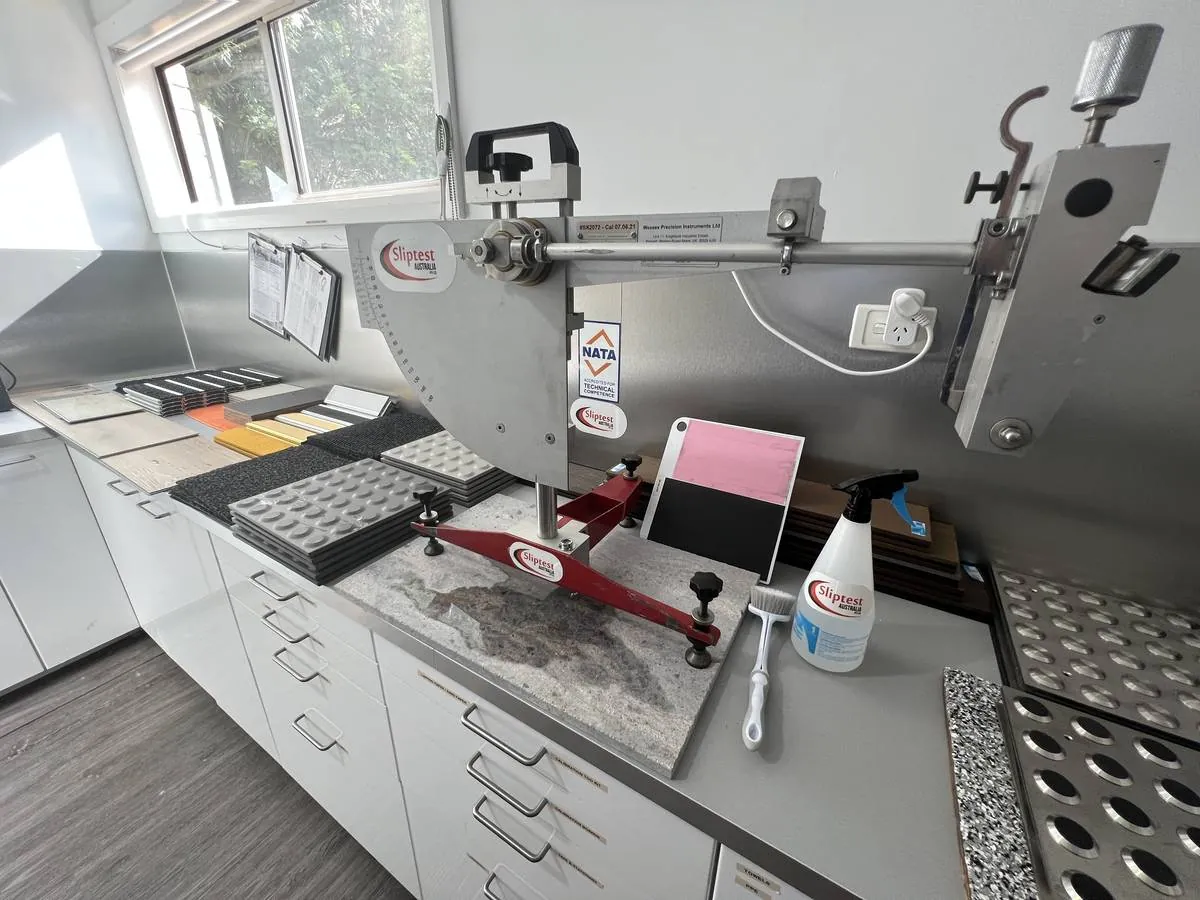
Pendulum and samples in the Sliptest NATA-accredited laboratory, Gold Coast
NATA No. 15374 Accreditation
AS 4586 New materials
P0 to P5 Wet pendulum
D0 / D1 Dry friction
Gold Coast lab Samples by courier
What It Is

Slip resistance classification before the floor goes down

AS 4586 is the Australian Standard for classifying the slip resistance of new pedestrian surface materials: tiles, stone, vinyl, timber, coatings, gratings, tactile indicators and any other product that people will walk on. The classification tells a specifier, certifier or builder whether the product will meet the P rating a location requires before it is bought and installed.

Sliptest Australia's NATA-accredited laboratory on the Gold Coast classifies products for manufacturers, importers, distributors, architects and builders across Australia. Samples are couriered to us, tested to the standard, and reported with the NATA endorsement that gives the result standing with the NCC, HB 198 and every Australian certifier.

Because we are an independent testing laboratory, not a flooring supplier, our classification carries no commercial interest in the result.

The Standard

The four classification methods in AS 4586

AS 4586 contains four test methods, each producing its own classification. They are not interchangeable and there is no formula to convert one to another. The wet pendulum P classification is the one the NCC and most Australian specifications call for.

Appendix A
Wet Pendulum Test, P0 to P5
The reference method. A rubber slider on a pendulum arm is swung across the wetted sample and the mean BPN is classified P0 to P5. Required by the NCC for stairs, ramps and landings and recommended by HB 198 for most other pedestrian areas.
Appendix B
Dry Floor Friction Test, D0 or D1
A Tortus floor friction tester measures the coefficient of friction on the dry sample. D1 (0.40 or more) or D0. Describes dry performance only and is usually reported alongside the wet pendulum result.
Appendix C
Wet Barefoot Inclining Platform, A, B or C
A barefoot operator walks on the wetted sample on an inclining ramp. Classes A, B and C are used for pool surrounds, change rooms and other wet barefoot areas, usually in addition to a Slider 55 pendulum result.
Appendix D
Oil-Wet Inclining Platform, R9 to R13
A shod operator walks on an oiled sample on an inclining ramp. R ratings are common on European product data sheets. They are not P ratings and do not on their own demonstrate NCC or HB 198 compliance.
Sliptest classifies to the wet pendulum and dry floor friction methods, which are the classifications Australian certifiers and the NCC rely on. If your specification calls for a ramp classification (A/B/C or R), talk to us and we will advise on the right test path.
Requirements

Which P rating does the product need to achieve?

The required classification depends on where the product will be used. The NCC sets minimums for stairs, ramps and landings in new buildings. For everything else, HB 198:2014 gives recommended classifications that most specifications adopt. A product should be classified against the most demanding location it will be installed in.

LocationWet pendulum classificationSource
Ramp steeper than 1:14P4 dry, P5 wetNCC
Ramp between 1:14 and 1:20P3 dry, P4 wetNCC
Stair treads, nosings and landingsP3 dry, P4 wetNCC
External colonnades, walkways, pedestrian crossingsP4HB 198
Entry foyers, wetP4HB 198
Entry foyers, dryP3HB 198
Shopping centre malls and food courtsP3HB 198
Commercial kitchens, loading docksP5HB 198
Swimming pool ramps and stairs into waterP5 (Slider 55), also class CHB 198
Swimming pool surrounds, communal showersP4 (Slider 55), also class BHB 198
Public toilets and amenitiesP3HB 198
The NCC requirement applies to new building work and is enforceable through the building approval. HB 198 is a guide, not law, but it is what certifiers and designers treat as the accepted benchmark. Our report states the classification achieved; the specifier decides which locations it can be used in.
How To Order

How laboratory classification works

Tell us the product and where it will be used

Product type, finish, intended locations and any specification you are working to. We confirm which method and slider apply.

We confirm sample requirements

Number of pieces, size and preparation. Tiles are tested on full pieces, coatings and vinyls on prepared panels. Different colours or finishes are separate classifications.

Courier samples to the laboratory

Our NATA-accredited laboratory is on the Gold Coast, Queensland. Samples are logged, conditioned and tested in a controlled environment to the standard.

Testing and classification

Wet pendulum with Slider 96 and, where the product will be used barefoot, Slider 55. Dry floor friction on request. Results are calculated and classified exactly as AS 4586 sets out.

NATA-endorsed report

You receive a NATA-endorsed classification report you can attach to data sheets, tenders, specifications and handover documentation.

Our Clients

Who uses AS 4586 laboratory classification

Manufacturers & Importers

P rating classification for tiles, stone, vinyl, timber, coatings, gratings and tactile indicators sold in Australia.

Architects & Specifiers

Independent confirmation that a specified product meets the P rating for each location before it is documented.

Builders & Developers

Evidence for certifiers that the selected product complies, before installation and again at handover.

Distributors & Retailers

Current Australian classifications for imported ranges that only carry R ratings or overseas data.

Anti-Slip Treatment Suppliers

Before and after classification of treated samples to substantiate performance claims.

Government & Councils

Product approval for aquatic centres, transport infrastructure and public buildings.

Common Questions

AS 4586 laboratory testing FAQ

AS 4586:2013, Slip resistance classification of new pedestrian surface materials, is the Australian Standard for classifying how slip resistant a floor material is before it is put into service. It sets out four laboratory test methods and the classification bands for each. The wet pendulum P classification (P0 to P5) is the one most specifications, the NCC and HB 198 refer to.
AS 4586 classifies new materials, usually in the laboratory on samples, and is used by manufacturers, specifiers and builders at handover. AS 4663 measures existing floors in service, on-site, and is used for periodic compliance, incidents and rectification. The wet pendulum method and the P bands are the same in both, the difference is whether the surface is new or has been walked on.
No. R9 to R13 come from the oil-wet inclining ramp test (AS 4586 Appendix D, based on the German DIN standard) and describe shod slip resistance on an oily ramp. P ratings come from the wet pendulum test. There is no exact conversion between them, and Australian certifiers and the NCC work in P ratings. If a product data sheet only quotes an R rating, the product needs a wet pendulum classification before it can be shown to meet an Australian P requirement.
It depends on the material and the test. As a guide, tiles and rigid sheet products are tested on several full pieces so that at least three separate test positions can be measured, and coatings or vinyls are usually supplied on prepared panels. We confirm the sample size, quantity and preparation when you book, so you only send what the method needs.
Once samples arrive at our Gold Coast laboratory, standard turnaround for a wet pendulum classification is a few business days. Urgent testing for tender deadlines or site programs can usually be arranged. Ask when you request a quote.
Yes. AS 4586 allows testing of newly installed surfaces in-situ before they are handed over. This is how construction handover testing is done, and it captures the effect of grout, installation and site finishing that a lab sample does not. See our construction handover page for how that works.
No. The classification describes the material as tested. Wear, polishing from cleaning, contamination and coatings all change slip resistance over time. HB 198 recommends periodic on-site testing to AS 4663 once a floor is in service, and many facility managers test high-risk areas annually.
Because a classification is only as good as the laboratory behind it. NATA accreditation to ISO/IEC 17025 means the equipment, calibration, method and staff have been independently assessed, and the report carries the NATA endorsement that certifiers, councils and insurers look for. Sliptest Australia holds NATA accreditation No. 15374.
Get in Touch

Request a classification quote

Tell us the product, finish and where it will be used. We will confirm the method, sample requirements, price and turnaround within one business day.

Request a Free Quote
Something went wrong. Please try again or call 1300 SLIPTEST.
Related Services

Other testing services

Need a product classified to AS 4586?

Send us the product details and we will confirm samples, method and turnaround within one business day.

Request a Quote 1300 SLIPTEST