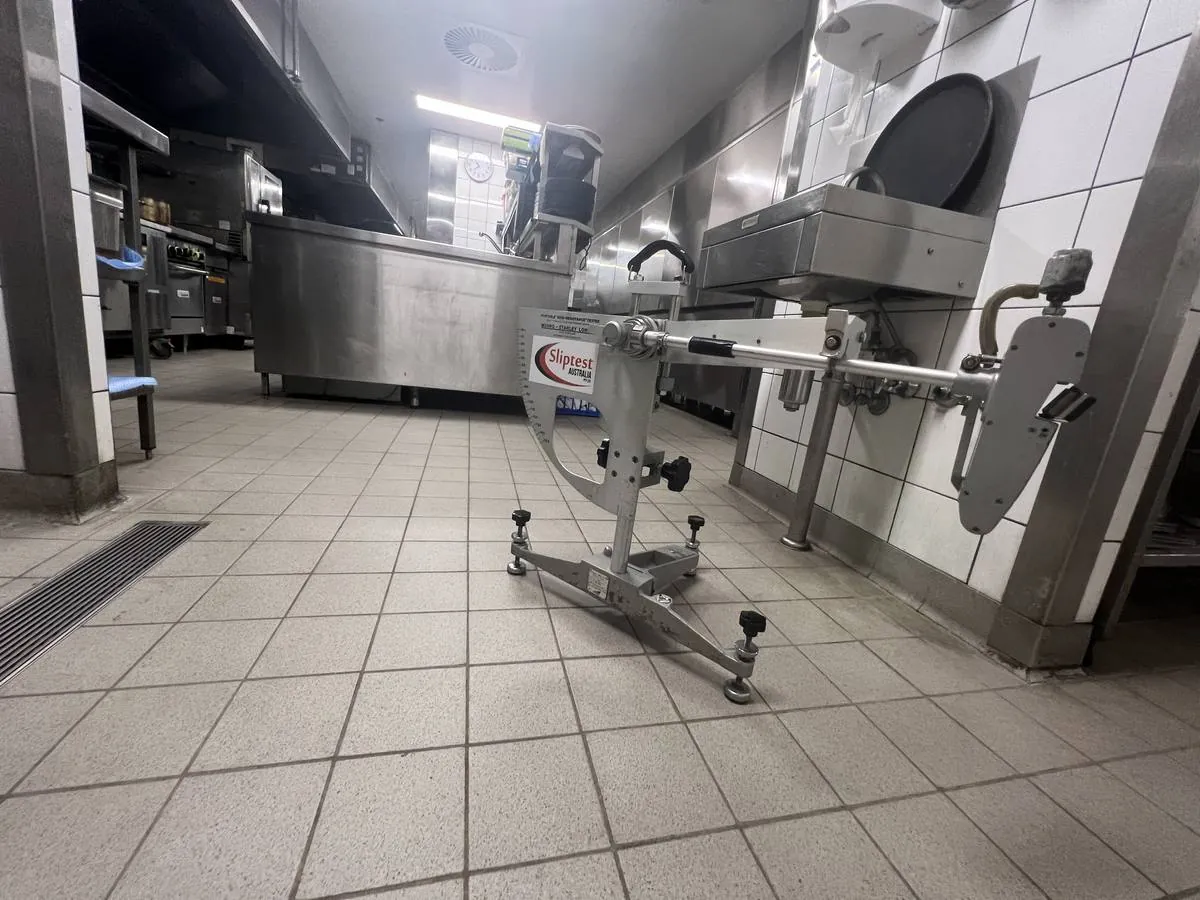
Facility managers, body corporate committees and property owners ask us this more than any other question. The honest answer is that no Australian standard or regulation says floors must be slip tested every twelve months, or at any other fixed interval. AS 4663 tells you how to test an existing floor. HB 198 recommends that surfaces in service are tested periodically. The interval is left to the person responsible for the site, because the right interval depends on the risk.
That puts the decision, and the record of the decision, on you. If a slip and fall becomes an insurance claim or a legal dispute, the question will not be whether you met a statutory interval. It will be whether you knew the condition of your floors and acted reasonably on what you knew. A testing program with a documented, risk-based frequency is how you answer that question.
This guide sets out how we help clients decide the frequency, what should trigger a test outside the cycle, and what a defensible program looks like.
The intervals below reflect what Sliptest recommends and what the facility management programs we run typically adopt. They are a starting point for your own risk assessment, not a rule. Move an area up the table if it has an incident history, heavy weather exposure or an aggressive cleaning regime.
| Area | Why the risk is higher or lower | Suggested interval |
|---|---|---|
| Pool surrounds, change rooms, communal showers | Wet, barefoot, high consequence, treatments wear quickly | Every 6 to 12 months |
| Commercial kitchens and back of house food areas | Grease and water contamination, constant cleaning with degreasers | Every 12 months |
| External entries, ramps, walkways and car parks | Rain exposure, tracked-in water, wear at high traffic points | Every 12 months |
| Shopping centre malls, food supermarket floors | Very high traffic, spills, frequent machine scrubbing that polishes surfaces | Every 12 months |
| Aged care and healthcare corridors, bathrooms | Vulnerable occupants, high consequence of a fall | Every 12 months |
| Stairs and landings in public buildings | Falls on stairs cause serious injury, nosings wear | Every 12 to 24 months |
| Office lobbies and internal dry areas | Lower risk unless wet at entries, slower change in condition | Every 24 to 36 months |
| Any area after an incident, treatment or change of use | Condition may have changed materially | Immediately, then back to cycle |
A cycle handles gradual change. These events change a floor's condition quickly, or change what you will be asked to prove, and each one should trigger a test regardless of where the site is in its cycle.
Test each distinct surface and risk zone once to AS 4663 so you know the starting classification for every area, not just the ones that have caused trouble.
Use the table above and your incident history. Write the interval and the reasoning into the site WHS plan or asset register.
We schedule around tenants and occupants. Results are reported within 24 hours of the visit with the classification against the requirement for each location.
Change the cleaning regime, treat, or replace, then retest so the record shows the floor was brought back to the required classification.
One portfolio summary listing every site, area, classification, test date and next due date. This is the document an insurer or lawyer will ask for.
Sliptest runs programs like this for facility managers, strata managers, aged care operators and councils across Australia. See slip testing for facility and property managers for how portfolio programs are set up and priced.
Tell us about the sites and we will propose a frequency and a quote within one business day.